Sectional sofas have become the go-to solution for modern living rooms, family rooms, and open-concept spaces. They’re not just oversized couches, they’re modular furniture systems that adapt to how people actually use their homes. Whether someone’s dealing with an awkward corner, hosting movie nights for six, or trying to define zones in a great room, a sectional offers flexibility that traditional sofas can’t match. But choosing the wrong size, configuration, or upholstery can turn a smart investment into a layout headache. This guide walks through the practical considerations, measurements, materials, configurations, and placement strategies, that separate a well-chosen sectional from one that dominates a room for all the wrong reasons.
Table of Contents
ToggleKey Takeaways
- A sofa sectional adapts to multiple room layouts and configurations—L-shaped, U-shaped, and curved—offering flexible seating for 5–7 people compared to 3 on a standard sofa.
- Accurate measurements of floor space, doorways, and traffic paths are essential before purchasing; use painter’s tape to outline the footprint and test traffic flow for 1–2 days.
- Performance fabrics and commercial-grade upholstery with a double rub count of 25,000+ cycles provide superior durability in high-traffic households with kids or pets.
- Float your sectional a few inches from walls rather than flush placement to create visual breathing room and define zones in open-concept spaces.
- Anchor your sectional with an appropriately sized rug (8′ x 10′ or larger), balance it with accent furniture, and layer multiple light sources to prevent the space from feeling crowded or dominated.
What Is a Sofa Sectional and Why Choose One?
A sectional sofa is a multi-piece seating unit designed to be arranged in various configurations. Unlike a standard three-seat sofa, sectionals consist of individual modules, armless chairs, corner pieces, chaises, and end units, that connect to form L-shapes, U-shapes, or custom layouts.
The main advantage is flexible seating capacity. A typical L-shaped sectional seats five to seven people comfortably, compared to three on a standard sofa. That makes them ideal for families, frequent hosts, or anyone who wants lounging options without crowding the room with multiple furniture pieces.
Sectionals also solve layout challenges. They fit naturally into corners, maximizing square footage in smaller rooms. In open-concept homes, a sectional can act as a room divider, anchoring the living area without blocking sightlines. The chaise component, a long, reclining extension, offers a spot to stretch out that a traditional sofa simply doesn’t provide.
One trade-off: sectionals are less portable. Moving a modular unit through doorways and up stairs requires disassembly, and reconfiguring them in a new space isn’t always straightforward. They also demand more floor space. A small sectional still occupies at least 90 to 110 inches along two walls, so they’re not ideal for every room.
Types of Sectional Sofas: Finding Your Perfect Configuration
Sectionals come in a handful of core configurations, each suited to different room shapes and traffic patterns. Choosing the right type starts with understanding how the space will be used and where doorways, windows, and focal points fall.
L-Shaped Sectionals
The most common configuration, L-shaped sectionals feature two perpendicular sections that form a 90-degree angle. One side typically includes a chaise lounge (a long seat without a backrest on one end), while the other is a standard sofa section with an arm.
These work well in square or rectangular rooms where one wall is longer than the other. The chaise extends into open floor space, so placement near a window or away from high-traffic zones prevents bottlenecks. Many interior designers prefer L-shapes for their balance of seating and walkability.
Some L-shaped models are reversible, meaning the chaise can be moved to either the left or right side. This flexibility is useful when changing layouts or moving homes. Fixed-chaise models are usually less expensive but lock the user into one configuration.
For rooms under 12 feet wide, a compact L-shaped sectional (around 80 to 90 inches on the long side) prevents the furniture from overwhelming the space. Larger rooms can accommodate units stretching 100 to 120 inches or more.
U-Shaped and Curved Sectionals
U-shaped sectionals add a third section, forming a horseshoe around a central coffee table or ottoman. They’re designed for large, open rooms, at minimum, a space that’s 14 feet by 14 feet, and prioritize seating capacity over mobility.
These configurations excel in dedicated media rooms or entertaining spaces where the sectional is the room’s anchor. The enclosed shape creates an intimate conversation zone, but it also blocks sightlines and makes it harder to navigate around the furniture. They’re not suited for rooms with multiple entry points or heavy foot traffic.
Curved sectionals follow a gentle arc rather than sharp angles. They soften the visual impact in contemporary spaces and work well in rooms with unconventional layouts. But, curved pieces are harder to move and reconfigure, and they typically cost more due to the manufacturing complexity. They’re also trickier to pair with rectangular coffee tables or rugs.
How to Measure Your Space for a Sectional Sofa
Measuring correctly is non-negotiable. A sectional that’s too large turns a room into an obstacle course: one that’s too small leaves awkward gaps and wasted space.
Start by mapping the total floor area. Measure wall-to-wall in both directions, then subtract space for doorways, windows, radiators, and electrical outlets. Note ceiling height if the room has low clearance, bulky sectionals with tall backs can make an 8-foot ceiling feel oppressive.
Next, measure the walkways. A minimum clearance of 30 inches is standard for main traffic paths: 18 inches works for secondary routes. Mark where people will naturally walk, from the entryway to the kitchen, around the coffee table, past the sectional to reach other seating.
For the sectional itself, measure both the overall footprint and the depth. Depth (front to back) typically ranges from 36 to 40 inches, but deep-seated models can hit 45 inches or more. Check whether the listed dimensions include legs, cushions, or arms, manufacturers aren’t always consistent.
Don’t forget doorways and staircases. Measure the narrowest point of every path the sectional will travel during delivery. Modular sectionals break down into individual pieces, but each piece still needs to fit through a 30- to 32-inch doorway and navigate any tight turns. If a staircase has a landing, measure the diagonal clearance.
Use painter’s tape to outline the sectional’s footprint on the floor. Live with the tape layout for a day or two. Walk around it, test traffic flow, and check sightlines to the TV or fireplace. Adjust before committing to a purchase.
Sectional Sofa Materials and Upholstery: What to Consider
Upholstery choice impacts durability, maintenance, and comfort. There’s no universal “best” fabric, it depends on household habits, climate, and aesthetic preferences.
Leather and faux leather offer durability and easy cleanup. Full-grain leather ages well and develops a patina, but it’s expensive and can crack without conditioning. Top-grain leather is more affordable and resists stains better. Faux leather (polyurethane or polyvinyl) costs less and works for households with kids or pets, but it doesn’t breathe as well and can peel after a few years.
For high-traffic homes, look for a double rub count (Wyzenbeek or Martindale test) of at least 25,000 to 30,000 cycles. Commercial-grade fabrics hit 100,000+ and hold up to daily wear.
Performance fabrics, like solution-dyed acrylic or polyester blends treated with stain repellents, handle spills, pet hair, and UV exposure better than untreated cotton or linen. Brands often market these under proprietary names, but the key feature is that the color is embedded into the fiber rather than applied as a dye. That prevents fading and makes cleaning more forgiving.
Cotton and linen provide a softer, more breathable feel, which suits warmer climates or modern design aesthetics. They wrinkle and stain more easily, so they’re better for low-traffic spaces or households without young children. Look for a tight weave and a stain-resistant treatment if choosing natural fibers.
Microfiber is a budget-friendly synthetic that resists stains and feels soft. It’s prone to pilling over time, and some people find it traps heat.
Frame construction matters as much as fabric. A solid hardwood frame (oak, maple, or birch) or kiln-dried engineered wood ensures the sectional won’t sag or creak after a year. Avoid frames made entirely of particleboard or softwoods like pine. Corner blocks, glued-and-doweled joints, and eight-way hand-tied springs are signs of quality construction, though they add to the price.
Styling and Placement Tips for Maximum Impact
Even a well-chosen sectional can feel off if it’s placed or styled poorly. A few layout principles make the difference between a cohesive room and a crowded one.
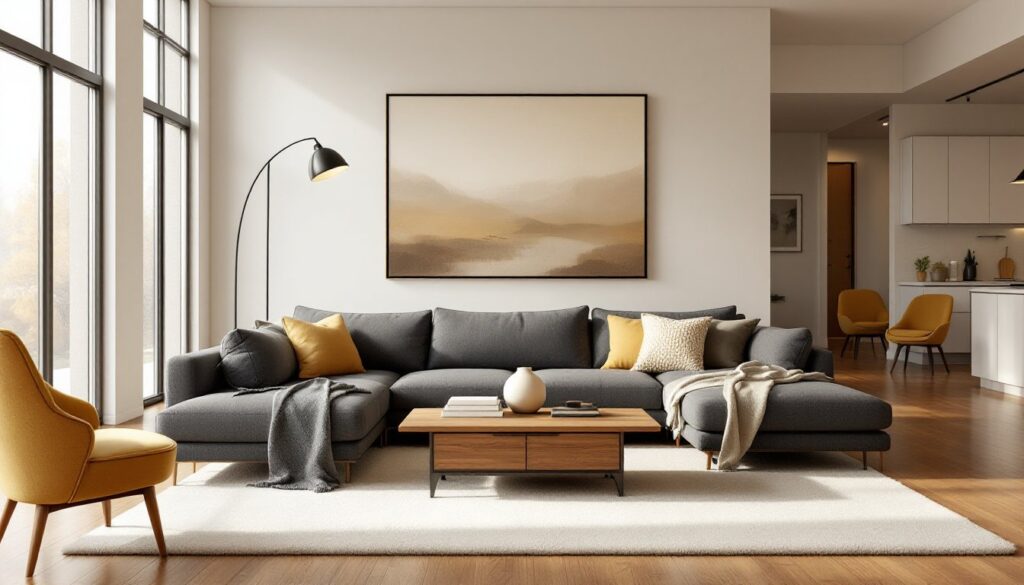
Float the sectional a few inches away from the walls rather than pushing it flush. This creates visual breathing room and prevents the space from feeling like a furniture showroom. In open-concept layouts, floating the sectional defines the living zone without blocking flow to the kitchen or dining area.
Orient the sectional to face the focal point, a fireplace, TV, or large window. If the room has competing focal points, choose the one used most often. Avoid placing the sectional with its back to a main entryway, which makes the space feel closed off.
Choose a coffee table that’s about two-thirds the length of the sectional’s longest side. Leave 14 to 18 inches of clearance between the table edge and the sectional for legroom. Round or oval tables work better with curved sectionals: rectangular tables suit L-shapes and U-shapes.
Anchor with a rug. The rug should be large enough that at least the front legs of the sectional rest on it, ideally, all pieces sit on the rug. An 8′ x 10′ or 9′ x 12′ rug is standard for most sectionals. Too-small rugs make the furniture look disconnected from the rest of the room.
Balance the sectional’s visual weight with other furniture. If the sectional dominates one side of the room, add a pair of accent chairs, a console table, or a tall bookshelf on the opposite side. This prevents the space from feeling lopsided.
Layer lighting. A sectional creates a large seating zone that often needs multiple light sources, a floor lamp at one end, table lamps on side tables, or pendant lights overhead. Avoid relying solely on overhead fixtures, which cast harsh shadows.
Keep throw pillows and blankets in check. Three to five pillows in varying sizes (18″, 20″, and 22″ square) add comfort without cluttering the seats. One or two throws draped over the chaise or armrest soften the look.
Sectionals are substantial pieces, but they don’t have to dominate. Thoughtful placement, proportional accessories, and attention to scale turn them into hardworking centerpieces that actually improve how a room functions.