Carpet cleaners have traditionally required a careful dance between the cleaning and drying buttons, adjusting your pace and technique to avoid over-wetting or leaving residue behind. The Hoover SmartWash eliminates that guesswork with automatic cleaning and drying modes that shift as you push and pull. It’s designed for homeowners who want deep-cleaned carpets without mastering the mechanics of a commercial machine. This guide covers what sets the SmartWash apart, how to operate it effectively, its performance on common household stains, and whether it’s the right tool for your home.
Table of Contents
ToggleKey Takeaways
- The Hoover SmartWash automatic carpet cleaner eliminates guesswork with hands-free cleaning and drying modes that activate based on directional movement, making it ideal for first-time users and large area cleaning.
- HeatForce technology reduces typical drying time from 6–8 hours to 1–3 hours by using heated airflow extraction, significantly faster than traditional carpet cleaners relying on suction alone.
- The FlexForce dual-action brushroll system and automatic two-pass rinse cycle (detergent wash on push, clean water rinse on pull) mimic professional extraction without requiring manual mode switching or trigger control.
- At $180–$250, the Hoover SmartWash pays for itself within 18 months compared to rental machines or professional cleaning services if you clean carpets more than twice a year.
- Proper maintenance—vacuuming first, rinsing tanks after each use, and making 2–3 drying passes—is essential to prevent clogging, mold, and extend the machine’s working life.
- The SmartWash excels on everyday pet accidents, mud, and water-soluble stains but is not designed for antique rugs, commercial use, or removing permanent damage like bleach stains or matted fibers.
What Makes the Hoover SmartWash Different from Traditional Carpet Cleaners?
Most carpet cleaners require you to press and hold a spray trigger or button while pushing forward, then release it while pulling back to extract. The SmartWash removes that manual control entirely. Its automatic cleaning mode dispenses solution and scrubs when you push forward, then switches to water-only rinsing and extraction when you pull back, no buttons, no triggers, just directional movement.
This matters most for first-time users or anyone cleaning large areas. You won’t accidentally over-saturate a section by holding the trigger too long, and you won’t skip rinsing because you forgot to switch modes. The machine enforces proper technique by design.
Unlike rental units, which often weigh 40+ pounds and have limited brush control, the SmartWash models typically weigh between 17 and 22 pounds depending on configuration. That makes them easier to maneuver around furniture and carry up stairs. The trade-off is a smaller solution tank (usually around 1.5 gallons) compared to commercial rentals, so you’ll refill more often on whole-house jobs.
Another distinction: the SmartWash uses HeatForce technology to accelerate drying. Traditional cleaners rely on suction alone. The heated airflow cuts typical drying time from 6–8 hours down to 1–3 hours, depending on humidity and carpet pile.
Key Features and Technology Behind the SmartWash System
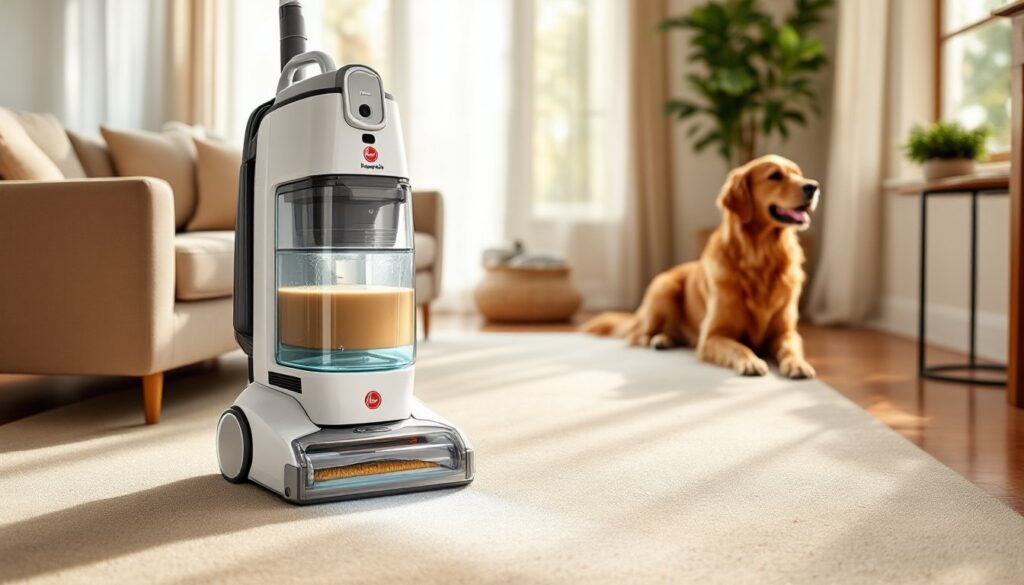
The core of the SmartWash is its FlexForce dual-action brushroll system, which combines stiff bristles for scrubbing and soft microfiber for lifting loosened dirt. The brushroll spins at a fixed speed (no manual adjustment), optimized for residential cut-pile and loop carpets.
Solution delivery happens through a set of front-mounted nozzles. When you push forward, the machine releases a pre-mixed cleaning solution (Hoover recommends its own formulas, but third-party solutions labeled for deep cleaners work if they’re low-foam). Pull back, and the system automatically switches to a clean water rinse, which flushes out detergent residue. This two-pass system mimics professional extraction without requiring you to think about it.
Dual tanks keep clean solution separate from dirty water. The clean water tank sits on top, while the dirty water tank collects below. Both are removable and translucent, so you can see when it’s time to empty or refill. Capacity varies by model, most SmartWash units hold about 1.5 gallons clean and 1.25 gallons dirty.
The control panel is minimal. Most models have a power button, a carpet/upholstery selector switch, and a HeatForce toggle. That’s it. There’s no pressure adjustment or brush speed control, which keeps operation simple but limits customization for delicate rugs or heavily soiled areas.
Automatic Cleaning and Drying Modes
The automatic cleaning mode is the headline feature, but it’s the drying cycle that separates the SmartWash from older designs. After you’ve cleaned a section, making a few extra dry passes (solution tank off, just suction and heat) pulls out residual moisture.
HeatForce activates a heating element that warms the air flowing through the vacuum path. This doesn’t heat the water going into the carpet, it heats the air being pulled out. Think of it as a forced-air dryer for your flooring. On high-traffic areas or dense carpets, run HeatForce for at least two additional passes after the cleaning cycle.
Drying time depends on carpet thickness, pad type, and room ventilation. A low-pile berber in a climate-controlled room with good airflow dries in about an hour. A plush, high-pile carpet over thick padding in a humid basement might still be damp after three hours. Open windows, run ceiling fans, and keep foot traffic off until the carpet passes the touch test, press a paper towel into the pile: if it comes up damp, give it more time.
How to Use Your Hoover SmartWash: Step-by-Step Setup and Operation
Prep work matters more than machine features. Vacuum thoroughly before you start. The SmartWash is a deep cleaner, not a vacuum. Hair, crumbs, and loose dirt will clog the brushroll and dirty water tank, reducing suction and cleaning power.
Setup steps:
- Fill the clean water tank with hot tap water up to the fill line. Hot water (not boiling, around 120–140°F) helps activate cleaning agents and loosens dirt.
- Add carpet cleaning solution according to the cap’s fill line. Hoover’s formula uses a concentrated ratio, usually 3–4 capfuls per tank. Overfilling creates excess foam, which can reduce suction.
- Lock the tank into place until you hear the click. A loose tank won’t dispense solution correctly.
- Plug in the machine and turn it on. Select carpet mode (not upholstery) for floors.
Cleaning process:
- Start in the farthest corner of the room and work backward toward the exit. You don’t want to walk on freshly cleaned carpet.
- Push forward slowly, about one foot per second. The machine dispenses solution and scrubs. If you see excess foam or puddling, you’re moving too slowly or overfilled the solution.
- Pull back at the same speed. The SmartWash rinses and extracts. You should see dirty water filling the lower tank.
- Overlap each pass by about two inches to avoid streaking.
- Make 2–3 forward-and-back passes per section for moderate soil. Heavily soiled areas (entryways, pet zones) may need 4–5 passes.
After cleaning, switch off solution flow and make 2–3 drying passes with HeatForce on. This step is critical. Residual moisture invites mold, attracts dirt, and leaves carpets feeling crunchy if detergent isn’t fully rinsed.
Post-cleaning:
- Empty the dirty water tank immediately. Letting it sit encourages bacterial growth and odors.
- Rinse both tanks with warm water.
- Remove the brushroll and rinse off hair and debris. Most SmartWash models have a quick-release brushroll, check your manual.
- Let all components air-dry before reassembling.
Performance on Different Carpet Types and Stains
The SmartWash handles low- to medium-pile residential carpets best. Cut-pile, textured, and berber styles clean evenly with good dirt extraction. High-pile or shag carpets take longer to dry and may require extra drying passes, the deep padding and dense fibers hold more water.
Loop-pile carpets (common in basements and commercial-style installs) respond well to the scrubbing action, but check for snagging. If the brushroll catches a loop, stop immediately and reverse. Hoover’s brushroll design minimizes this, but it’s not impossible.
Stain performance:
- Mud and tracked-in dirt: Excellent. The dual-action brushroll and hot water lift embedded soil in 2–3 passes.
- Pet urine (fresh): Good, if treated quickly. Blot first, then clean. The rinse cycle helps remove urine salts that attract re-soiling. For set-in urine stains, pre-treat with an enzyme cleaner before running the SmartWash.
- Coffee, wine, juice: Very good on recent spills. Older, set stains may lighten but not fully disappear. Pre-treating with a spot cleaner improves results.
- Grease and oil-based stains: Fair. Carpet cleaners excel at water-soluble stains. Grease requires a degreasing pre-treatment or a solvent-based spot cleaner before deep cleaning.
Many carpet cleaners for pet messes are tested specifically for urine, vomit, and feces, and the SmartWash consistently ranks well for everyday pet accidents when used immediately.
What it won’t do: Remove bleach stains, dye transfer, or fiber damage. Those are permanent. It also won’t restore matted, crushed traffic lanes to like-new fluff, that’s a fiber compression issue, not dirt. And if your carpet hasn’t been cleaned in years, the first pass might bring up a lot of soil, but it may take two full cleanings (a week apart) to fully refresh the fibers.
Maintenance Tips to Keep Your SmartWash Running Like New
After every use:
- Rinse the dirty water tank and lid with warm water. Wipe the gasket around the tank opening, hair and lint build up there and break the seal, causing leaks.
- Remove and rinse the brushroll. Hair wraps around the ends. Scissors or a seam ripper make quick work of tangled fibers.
- Wipe down the nozzle area under the machine with a damp cloth. Dried detergent clogs the spray jets.
Monthly (or every 3–4 uses):
- Run a full tank of hot water only (no solution) through the machine on a scrap section of carpet or over a large towel. This flushes internal lines and prevents detergent buildup in the pump.
- Check the intake screen on the dirty water tank. Some models have a small mesh filter that catches larger debris. Rinse it under running water.
Every 6 months:
- Inspect hoses for cracks or kinks. The hose that runs from the dirty water tank to the nozzle can develop weak spots, especially if you store the machine in a cold garage.
- Check the brushroll bearings. If the brush doesn’t spin freely or makes grinding noises, the bearings may need replacement. Hoover sells replacement brushrolls for around $20–$30.
Storage:
Store the SmartWash in a climate-controlled space if possible. Freezing temperatures can crack plastic tanks and damage seals. If you must store it in a garage or shed, make absolutely sure all water is drained from tanks, hoses, and internal lines. Run the machine for 30 seconds with empty tanks to blow out residual water.
Many homeowners also reference general cleaning tips from trusted sources for maintaining household appliances, which applies equally to carpet cleaners. Keeping your machine clean extends its working life and maintains suction power.
Is the Hoover SmartWash Worth It for Your Home?
Best fit:
- Households with kids, pets, or high foot traffic who clean carpets 3–4 times a year or more.
- Homeowners who want a simple, automatic system without a learning curve.
- Anyone who’s rented a carpet cleaner before and found it too heavy or cumbersome.
Not ideal if:
- You have mostly hard floors and only a small area rug or two. A spot cleaner or manual scrubbing is more efficient.
- Your carpets are antique, delicate, or high-end wool. Those often require professional dry cleaning or low-moisture methods.
- You need a machine for commercial or rental use. The SmartWash is built for residential frequency, not daily operation.
Cost context:
As of early 2026, the Hoover SmartWash retails between $180 and $250 depending on the model and included accessories. That’s roughly the cost of 3–4 professional carpet cleaning sessions or 6–8 rental machine uses. If you clean your carpets more than twice a year, the machine pays for itself within 18 months.
Solution costs vary. Hoover-brand formulas run about $12–$15 per 50-ounce bottle, which handles 8–10 full tanks. Generic alternatives cost less but check the label, high-foaming formulas reduce suction and cleaning performance.
For broader advice on maintaining floors and home surfaces, sites like The Spruce offer complementary guides on everything from grout cleaning to hardwood care, useful for whole-home maintenance planning.
Final take:
The Hoover SmartWash delivers on its automatic promise. It won’t replace professional truck-mounted extraction for heavily soiled or water-damaged carpet, but for routine maintenance and spot deep cleaning, it’s one of the most user-friendly machines in the residential category. The learning curve is nearly flat, which matters if you’re the type who avoids complicated tools. Just don’t skip the prep work, vacuum first, rinse thoroughly, and let the carpet dry fully before moving furniture back.