Most homeowners never think about their refrigerator’s electrical demand until they’re planning a kitchen remodel, troubleshooting a tripped breaker, or sizing a backup generator. But knowing the amp draw of a refrigerator is essential for several practical reasons: it helps you determine whether your existing circuit can handle a new unit, calculate running costs, and prevent overloaded circuits that pose fire hazards. Understanding how much current does a refrigerator draw isn’t just an academic exercise, it’s foundational knowledge for safe, efficient home electrical management. This guide breaks down typical amp usage across refrigerator types, shows you how to calculate your specific model’s draw, and explains why it matters for your home’s electrical system.
Table of Contents
ToggleKey Takeaways
- Most refrigerators draw 3–7 amps while running, but surge amps can reach 15–20 amps at startup, which is why a dedicated 15–20 amp circuit is required by the National Electrical Code.
- Refrigerator amp usage varies significantly by type: standard top-freezer models draw 3–5 amps, while larger French door models with ice makers draw 5–7 amps, with smart features adding 0.2–0.5 amps continuously.
- To find your refrigerator’s exact amp draw, check the data plate inside the unit, use a plug-in energy monitor (the most accurate method), or calculate from the EnergyGuide label by dividing annual kWh by 8,760 hours and voltage.
- Proper generator sizing for backup power must account for starting watts (often 3× running watts), and refrigerator amp draw affects overall electrical panel load calculations during kitchen remodels or upgrades.
- Simple maintenance like cleaning condenser coils every six months, replacing worn door gaskets, and setting the temperature to FDA recommendations (37°F fridge, 0°F freezer) can reduce amp draw by 10–15%.
Understanding Refrigerator Amp Draw: The Basics
Refrigerators don’t draw a constant amount of current. The amp draw for refrigerator units fluctuates based on the compressor cycle, with the highest surge occurring at startup when the compressor motor kicks on.
Starting (surge) amps can reach 15–20 amps for a split second as the motor overcomes inertia. This is why your lights might dim momentarily when the fridge starts up.
Running amps are much lower, typically between 3 and 7 amps for most residential models. This is the sustained current the unit draws while the compressor is actively cooling.
Once the interior reaches the set temperature, the compressor cycles off, and the refrigerator drops to near-zero draw, using only minimal power for the control board and interior light. Over a 24-hour period, a fridge might run 8–12 hours total, depending on ambient temperature, door openings, and load.
Most refrigerators in the U.S. run on standard 120-volt circuits, which means a dedicated 15-amp or 20-amp circuit is sufficient, and required by the National Electrical Code (NEC) for kitchen appliances. Larger commercial-style units or some high-capacity models may require a 20-amp circuit to handle sustained load safely.
Understanding these distinctions helps you size circuits correctly and avoid nuisance trips. If you’re installing a new refrigerator on a shared circuit with other appliances, you’re asking for trouble.
Average Amp Usage for Different Refrigerator Types
Not all refrigerators pull the same current. Size, configuration, and features all affect the amp draw of refrigerator models. Here’s what to expect across common types.
Standard Top-Freezer and Bottom-Freezer Models
These are the workhorses of American kitchens, simple, efficient, and typically the lowest in amp consumption.
- Capacity: 18–22 cubic feet
- Running amps: 3–5 amps
- Startup surge: 12–15 amps
- Annual energy use: 300–450 kWh
Top-freezer units, in particular, are the most energy-efficient configuration because cold air naturally falls, reducing compressor work. If you’re replacing an older unit (pre-2000), expect your new model to draw 30–40% less current thanks to improved insulation, variable-speed compressors, and better door seals.
Bottom-freezer models draw slightly more due to the need to pump cold air upward, but the difference is minimal, usually 0.5–1 amp during running cycles.
Side-by-Side and French Door Refrigerators
These premium configurations offer more interior space, multiple cooling zones, and convenience features, but they come with higher electrical demands.
- Capacity: 22–30 cubic feet
- Running amps: 5–7 amps
- Startup surge: 15–20 amps
- Annual energy use: 500–700 kWh
French door models with bottom freezers and through-the-door ice/water dispensers are especially power-hungry. The ice maker alone can add 0.5–1 amp to the running load, and models with Wi-Fi connectivity, internal cameras, or LCD screens may draw an additional 0.2–0.5 amps continuously for electronics.
If you’re comparing models, check the yellow EnergyGuide label for estimated annual kWh usage. Divide that number by 8,760 hours, then by your home’s voltage (typically 120V) to get an average hourly amp estimate. For example, a unit rated at 600 kWh/year averages about 0.68 amps continuously, though actual draw will spike higher during compressor cycles.
How to Calculate Your Refrigerator’s Amp Usage
You don’t need to guess. Here’s how to find or calculate your refrigerator’s actual current draw.
Step 1: Check the data plate. Open the door and look for a metal tag inside the fridge compartment or along the interior sidewall. It’ll list:
- Voltage (V): Usually 115V or 120V
- Frequency: 60 Hz
- Rated amps or watts
If the plate lists watts (e.g., 700W), divide by voltage to get amps:
Amps = Watts ÷ Volts
700W ÷ 120V = 5.83 amps
That’s the maximum running draw, not the surge.
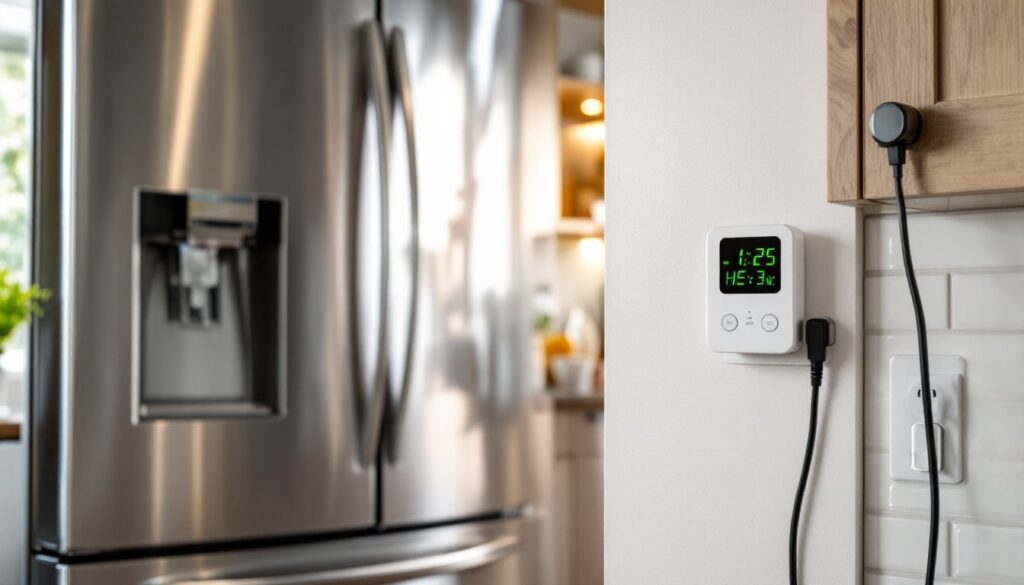
Step 2: Use a plug-in energy monitor. Devices like the Kill A Watt meter plug into the outlet, then the fridge plugs into the monitor. Over 24 hours, it’ll log peak amps, average amps, total watt-hours, and cost. This is the most accurate method and costs about $25.
Step 3: Measure with a clamp meter (advanced). If you’re comfortable working around electrical panels, a clamp ammeter can measure live current on the circuit wire without breaking the connection. This method is useful if you’re troubleshooting or verifying circuit load for code compliance, especially when adding kitchen circuits for multiple appliances.
Step 4: Estimate from the EnergyGuide label. If you know the annual kWh rating (say, 450 kWh), divide by 8,760 hours and then by 120V:
450,000 Wh ÷ 8,760 hours = 51.4W average
51.4W ÷ 120V = 0.43 amps average
This is useful for cost estimates, but remember: surge amps are much higher and matter for circuit breaker sizing.
Why Refrigerator Amp Draw Matters for Your Home
Understanding current draw isn’t just trivia, it has real implications for safety, remodeling, and backup power.
Circuit capacity and NEC compliance: The National Electrical Code requires that continuous loads (those running more than three hours) not exceed 80% of the circuit rating. A 15-amp circuit should carry no more than 12 amps continuously: a 20-amp circuit maxes out at 16 amps. If your refrigerator draws 6 amps running and shares a circuit with a microwave (10–12 amps), you’ll trip the breaker regularly.
Refrigerators should be on a dedicated circuit, one that serves only that appliance. This is standard practice in modern kitchen wiring and is required in many jurisdictions for major appliances.
Generator sizing: If you’re shopping for a portable or standby generator for power outages, you need to account for starting watts, not just running watts. A fridge that runs on 600W might need 1,800W at startup. Undersizing your generator means the fridge won’t start, or it’ll stall other loads when the compressor kicks on.
For whole-home backup, add up all simultaneous loads, including HVAC, well pumps, and lights. Refrigerator draw is usually modest, but surge capacity matters.
Electrical panel load calculations: During kitchen remodels or service panel upgrades, electricians perform load calculations to ensure the panel can handle all branch circuits. Knowing your refrigerator’s actual draw and model type helps size the panel accurately, especially if you’re adding high-draw appliances like induction ranges or second refrigerators in the garage.
Energy cost tracking: At $0.13/kWh (national average), a fridge using 500 kWh annually costs about $65/year. Older units can cost $100–$150. If your fridge is over 15 years old, replacement often pays for itself in energy savings within 5–7 years, aside from reliability gains.
Tips to Reduce Your Refrigerator’s Energy Consumption
Even without replacing your fridge, you can lower its amp draw and energy use with a few practical tweaks.
Set the temperature correctly. The FDA recommends 37°F for the fridge and 0°F for the freezer. Every degree colder than necessary increases energy use by about 5%. Use an appliance thermometer to verify, built-in dials are often inaccurate.
Check and replace door gaskets. A worn or torn gasket lets warm air in, forcing the compressor to run longer. Close the door on a dollar bill: if it slides out easily, the seal is weak. Replacement gaskets cost $50–$100 and are DIY-friendly on most models.
Clean the condenser coils. Dust and pet hair on the coils (located on the back or bottom) act as insulation, reducing heat transfer efficiency. Unplug the unit, vacuum the coils with a brush attachment, and wipe with a damp cloth every six months. This alone can cut energy use by 10–15%.
Ensure proper clearance. Refrigerators need airflow around the condenser. Leave at least 1–2 inches between the back of the unit and the wall, and don’t box in the sides unless the manufacturer specifies built-in ventilation.
Minimize door openings and load warm food carefully. Every time you open the door, warm, humid air rushes in. Let leftovers cool to room temperature before refrigerating (but don’t leave perishables out more than two hours). Keep the fridge 70–80% full, too empty and it loses thermal mass: too full and air can’t circulate.
Upgrade to an ENERGY STAR model. If your unit is 10+ years old, replacement is the single best efficiency move. ENERGY STAR refrigerators use 9–10% less energy than federal minimums. Modern inverter compressors modulate speed instead of cycling on/off, which reduces both amp spikes and wear.
For more detailed appliance maintenance and energy-saving strategies, consult manufacturer guidelines specific to your model. Some units have energy-saver modes or vacation settings that reduce draw when you’re away.
Safety note: Always unplug the refrigerator before performing maintenance on coils or internal components. If you’re working inside the electrical panel to verify circuits or install a dedicated line, turn off the main breaker and use a non-contact voltage tester to confirm wires are de-energized. Electrical work beyond basic outlet replacement typically requires a permit and licensed electrician, especially for new circuits or panel upgrades.